When Google Ads Is Not the Right Next Step
Learn when to delay Google Ads and how demand, economics, lead follow-up, CRM readiness, and attribution shape measurable growth.

Google Ads is often discussed as a simple yes-or-no decision. A company either runs ads or does not. When performance becomes difficult to explain, the channel itself is frequently blamed, paused, or replaced.
That framing is incomplete. Paid search can capture existing demand, but it cannot create healthy unit economics, repair a weak sales process, define a lead inside a CRM, or decide how revenue should be attributed. Those conditions belong to the wider business system.
A responsible recommendation may be to launch Google Ads, prepare the business first, or decide that another investment is more appropriate. The goal is not to defend ad spend. The goal is to build a measurable path from demand to revenue.
Key idea: The useful question is not simply, “Does Google Ads work?” It is, “Can this business turn paid demand into profitable, measurable outcomes?”
Google Ads is part of a business system
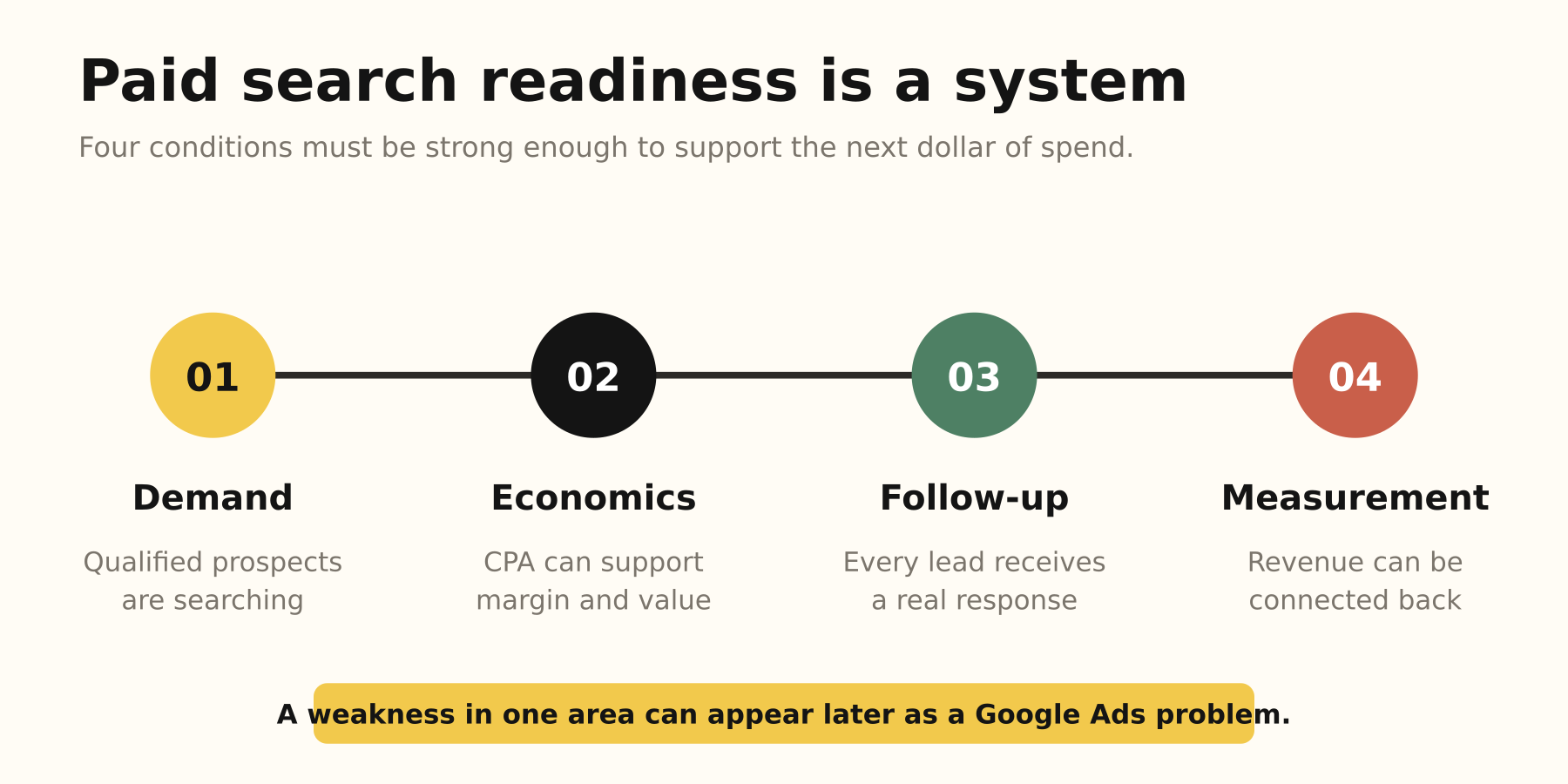
Google Ads performance depends on more than campaign structure, keywords, bidding, and creative. Four conditions determine whether paid search has a fair chance to produce useful business outcomes.
- Demand exists: Qualified prospects are actively searching for the service in the locations the business can serve.
- The economics work: Budget, margin, close rate, and customer value can support the expected cost per acquisition.
- Leads are handled: Every inquiry has an owner, a response expectation, and a consistent status inside a lead log or CRM.
- Impact is measurable: Platform activity, CRM progression, and recognized revenue are connected without forcing one report to answer every question.
AI-driven decisions can fail when the context is incomplete
AI can be a useful reviewer. It can identify risk, challenge assumptions, summarize performance, and suggest questions a team may have overlooked. The problem begins when a generic prompt is treated as a complete business diagnosis.
For example, asking an AI tool whether a company should stop Google Ads may produce a confident answer even when the tool has not seen the account economics, the conversion setup, the CRM, the sales cycle, or the quality of follow-up. A recommendation can sound precise while being built on a partial description.
A useful AI review should receive at least:
- A meaningful date range, budget history, and account-change timeline.
- The conversion actions that bidding actually optimizes toward.
- Search terms, geographic coverage, offer, and landing-page experience.
- Target CPA, gross margin, close rate, and estimated customer value.
- CRM stages, lead status definitions, and follow-up performance.
- The sales cycle and the attribution logic used by the business.
Practical rule: Use AI as a challenger and analytical assistant. Keep final accountability with people who understand the business, the customer journey, and the underlying data.
Paid media cannot compensate for weak lead follow-up
An ad click is not revenue. Even a completed form or phone call is only an opportunity. The commercial result depends on what happens after the lead arrives.
If inquiries sit inside inboxes, calls are not returned, or sales representatives use inconsistent status labels, the business cannot separate media quality from sales-process leakage. The agency may report valid conversions while the client sees little recognized revenue. Both views can be technically accurate and still fail to explain the complete journey.
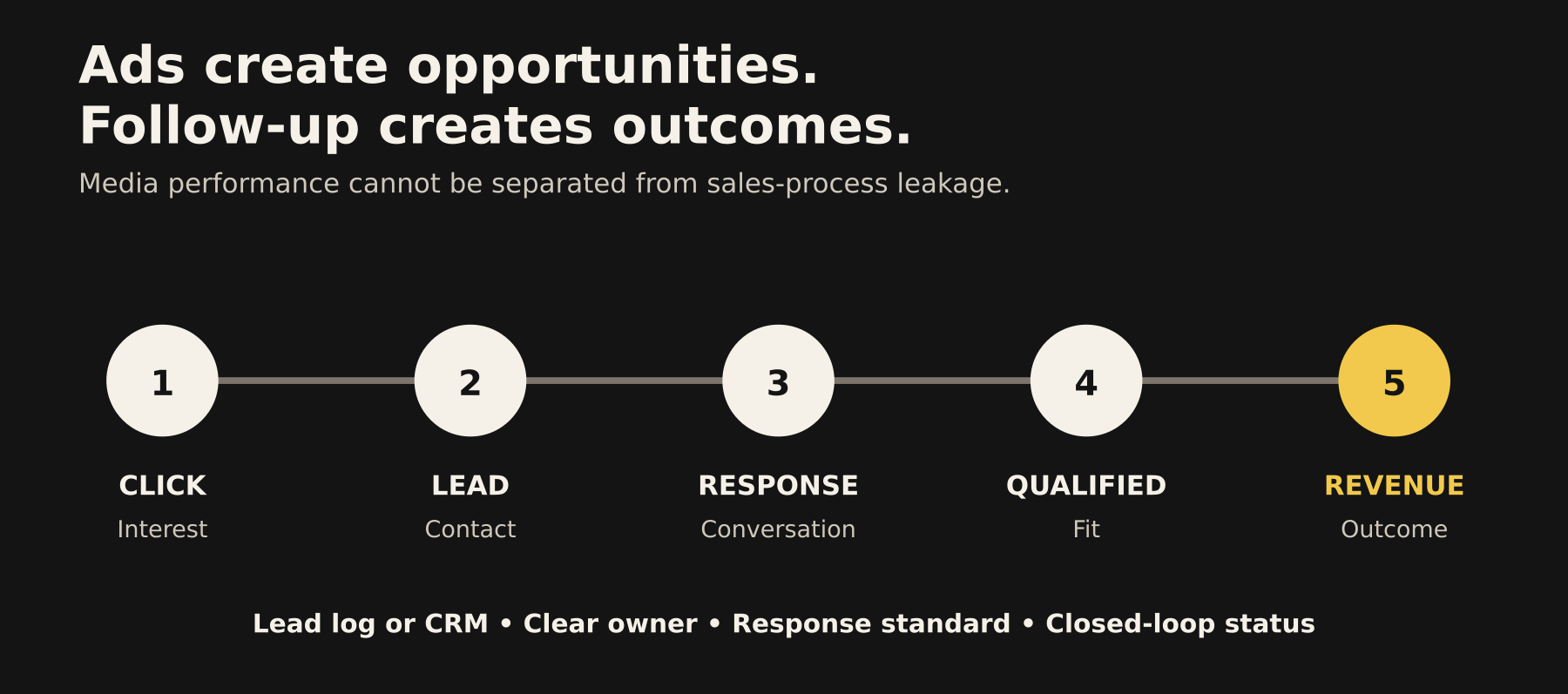
Before increasing spend, answer four operational questions:
- Where is every new lead recorded?
- Who owns the first response?
- How quickly should the first contact attempt occur?
- Which statuses show contacted, qualified, booked, won, and lost?
A sophisticated CRM is not always required on day one. A disciplined lead log can be enough for a smaller business. What matters is that the process is consistent, visible, and capable of returning outcomes to the marketing team.
Attribution disagreement is often a measurement-design problem
Marketing attribution becomes contentious when different systems are expected to produce the same answer. Google Ads, call tracking, web analytics, a CRM, and accounting records observe different parts of the customer journey.
The ad platform is useful for understanding which campaigns, queries, ads, and audiences generated or assisted demand. The CRM is useful for understanding whether a lead was contacted, qualified, booked, or lost. Revenue systems are useful for confirming what the business ultimately recognized. None of these sources should be treated as the entire truth in isolation.
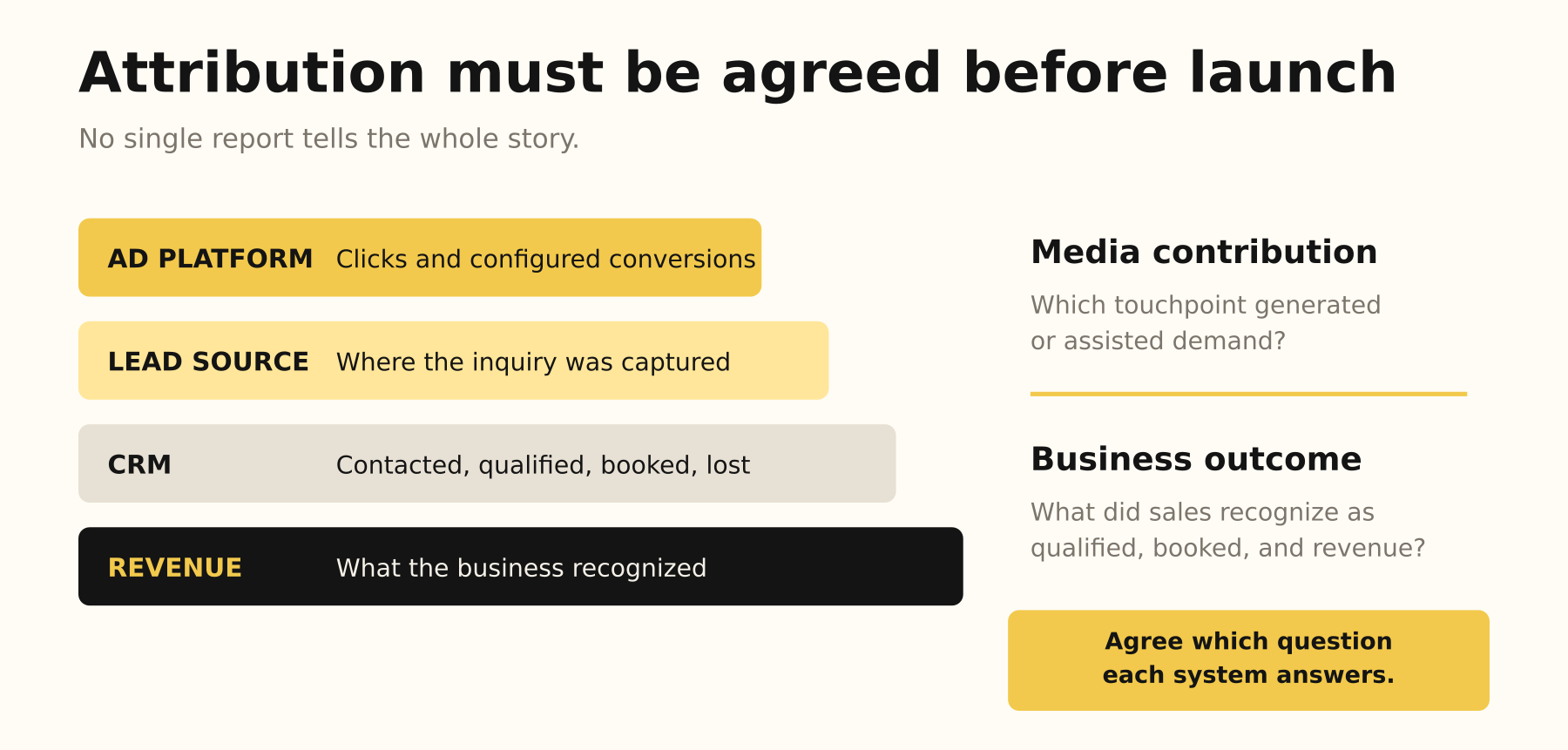
What each reporting layer should answer
- Ad platform: Which paid activity generated or assisted the conversion signals used for optimization?
- Lead source: Where was the inquiry captured, and which source information arrived with it?
- CRM: What happened after the inquiry entered the sales process?
- Revenue: Which opportunities became recognized business?
When those definitions are agreed before launch, reporting becomes a discussion about evidence and improvement. Without that agreement, a later disagreement about sales may be interpreted as a campaign failure even when the real issue is attribution design.
When it may be better to delay Google Ads
There are legitimate situations in which launching or continuing Google Ads is not the best immediate recommendation.
- Insufficient demand: The relevant search activity is too limited, too broad, or concentrated outside the serviceable market.
- Unsustainable economics: The likely acquisition cost cannot be supported by margin, close rate, or customer value.
- An unready offer or destination: The landing page, pricing logic, phone experience, or form journey prevents qualified prospects from taking the next step.
- No follow-up capacity: There is no consistent owner, response process, or lead-status discipline.
- Missing measurement definitions: The business has not agreed on what counts as a lead, qualified lead, booked opportunity, or sale.
- Insufficient service capacity: The business cannot fulfill additional demand without damaging the customer experience.
Important: Delay is not failure. It is a decision to fix the conditions that limit the return on ad spend before committing budget to a system that is not ready to convert it.
A readiness framework before launching Google Ads
| Condition | Ready signal | Not-ready signal |
|---|---|---|
| Demand | Qualified search volume exists in the serviceable area. | Volume is low, irrelevant, or outside reach. |
| Economics | CPA is sustainable at expected margin and close rate. | Acquisition cost exceeds what the unit economics support. |
| Follow-up | Leads have an owner, a response time, and consistent status tracking. | Leads go to shared inboxes with no defined owner. |
| Measurement | Lead, qualified lead, and revenue are defined. | Reports use conflicting definitions. |
Define the measurement contract before launch
The readiness conversation should end with a written measurement agreement. This is not an agency disclaimer. It is a shared definition of how performance will be evaluated.
- A lead is: the first agreed conversion threshold.
- Qualified means: the fit criteria the sales team will apply.
- Follow-up owner: the person accountable for the first response.
- Response target: the expected time to the first contact attempt.
- Source of truth: the system used for the final lead and revenue status.
- Attribution window: the period in which a channel may receive credit.
- Revenue match: the method used to return closed business to reporting.
- Review cadence: the point at which there is enough evidence to make a decision.
If these definitions change, the report changes. Any material change should be documented before the team judges campaign performance.
The final recommendation: Launch, Prepare, or Pass
Launch
The demand, economics, follow-up, and measurement conditions are strong enough to begin. The proposal should document the baseline, scope, conversion definitions, and initial learning period.
Prepare
The opportunity appears viable, but one or more readiness gaps should be fixed before media spend begins. The next step may be a short readiness sprint focused on tracking, landing pages, CRM stages, or lead handling.
Pass
The current demand or economics do not support Google Ads as the next best investment. The responsible recommendation is to preserve budget and identify a better channel, offer, market, or operational priority.
Bottom line: The objective is not to spend on ads. It is to create a measurable path from demand to revenue.
Conclusion
Google Ads can be an effective demand-capture channel, but the campaign is only one part of the growth system. AI-generated advice, media reports, CRM data, and revenue records become useful when they are interpreted within the same operating context.
A better sales process begins with readiness. Confirm demand, validate the economics, establish follow-up ownership, and agree on attribution before launch. That preparation protects both the client and the agency, and it creates a clearer basis for optimization when the campaign is live.
If you are evaluating Google Ads, contact me to determine whether the right next step is to launch, prepare, or invest elsewhere.
Frequently asked questions
Can AI determine whether a company should stop Google Ads?
AI can identify risks and analyze supplied evidence, but its recommendation is only as complete as the context it receives. Account economics, conversion definitions, CRM data, follow-up performance, and attribution logic should be included before treating the answer as a business decision.
Does a business need a CRM before running Google Ads?
Not always. A disciplined lead log may be sufficient for a smaller operation. The essential requirement is a consistent process for assigning, contacting, qualifying, and closing the loop on every lead.
Why do Google Ads and CRM reports show different results?
They observe different parts of the journey and may use different attribution windows, identifiers, and conversion definitions. The difference is not automatically an error, but the reporting roles should be agreed before launch.
How should a business decide whether to launch, prepare, or pass?
Evaluate the strength of demand, unit economics, landing experience, lead follow-up, service capacity, and measurement. Launch when the system is ready, prepare when the opportunity is viable but blocked, and pass when the economics or demand do not justify the investment.